



Denmark Pumps CO₂ Into the North Sea: Inside the EU’s First Full-Scale Storage Site.
On 18 September 2026, His Majesty King Frederik X of Denmark officially opened Greensand at the Port of Esbjerg – the first full-scale facility in the European Union for permanently storing CO₂ beneath the seabed. The project is led by INEOS Energy, with partners Harbour Energy and the Danish North Sea Fund (Nordsøfonden).
How It Works.
Greensand is a complete carbon capture and storage (CCS) value chain: CO₂ is captured, transported by ship, and pumped permanently into the seabed of the Danish North Sea.
- A dedicated CO₂ terminal at the Port of Esbjerg temporarily stores liquefied CO₂ arriving by truck from capture sites.
- The CO₂ is shipped offshore aboard Carbon Destroyer 1, the EU’s first purpose-built, dedicated CO₂ carrier vessel.
- The greenhouse gas is injected into the Nini West reservoir, a depleted oil field roughly 250 kilometres offshore, about 1,800 metres beneath the seabed.
- The reservoir’s integrity has been tested by the Geological Survey of Denmark and Greenland (GEUS), and Greensand has received safety approval from the independent verifier DNV.
In this first commercial phase, the site can store up to 400,000 tonnes of CO₂ annually. It has been designed to expand significantly, with the potential to reach 4–8 million tonnes per year as demand grows.
A Milestone, With Caveats.
The opening caps a 2021 political agreement in which the Danish parliament set aside 16 billion kroner to support CCS – originally aiming for a 2025 start, now delayed by a year.
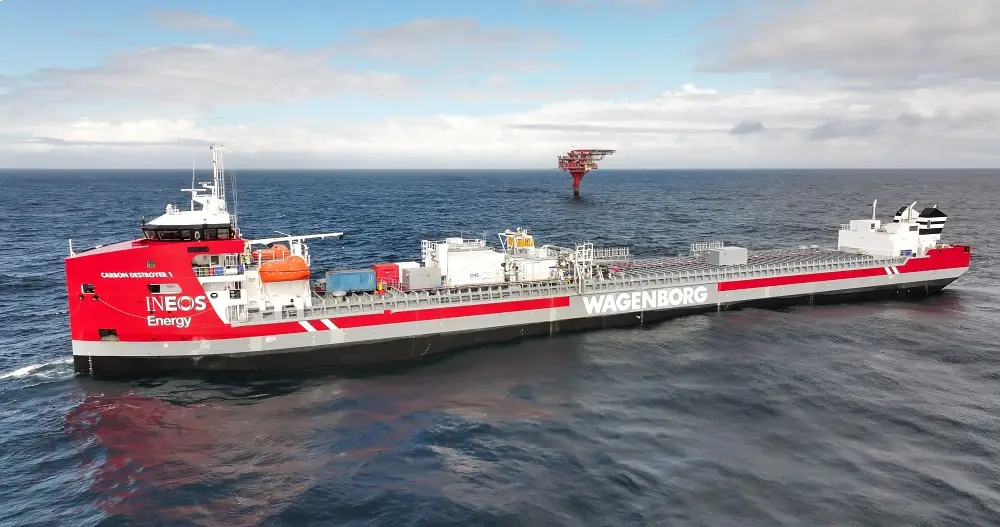
One notable limitation: the CO₂ currently entering the value chain comes primarily from Danish biomethane producers, partly because sufficient capture capacity at industrial smokestacks is not yet in place. As Mads Gade, CEO of INEOS Energy Europe, put it, Greensand “starts with biogenic CO₂, but its significance reaches far beyond that first step,” adding that the facility is “open for business.”
Reactions have been mixed. From the business side, the tone is enthusiastic: Danish Industry’s CEO, Lars Sandahl Sørensen, calls the opening a breakthrough for both Danish and European climate policy, pointing out that Greensand proves the entire chain – from capture to permanent storage — can work in practice. At the same time, the project faces ongoing criticism over cost and the pace of scaling, and INEOS’s Mads Gade has said continued state support will be needed to get the industry going, much as was historically the case for wind energy.
Why It Matters.
For years, Carbon Capture and Storage in Europe was defined largely by plans and targets. Greensand brings the EU’s first full-scale CO₂ storage site and value chain into operation – a practical route to cutting industrial emissions without shutting down the industries Europe depends on. The question that follows is how quickly the EU establishes the regulatory, infrastructure and investment conditions that let industrial emitters capture CO₂ at scale.