



A late-autumn swim, and the fog that predicts the day
Saturday morning, half past seven, and the window shows nothing at all – no hedge, no field, no line of trees, and no sign of the old mill behind the barn. The morning has mislaid its edges. I pull on wool, take the thermos and prepare the coffee that will be waiting when I get back, and go out into it.
Because this is mosekonebryg. The bog woman is brewing.
The name, and the weather
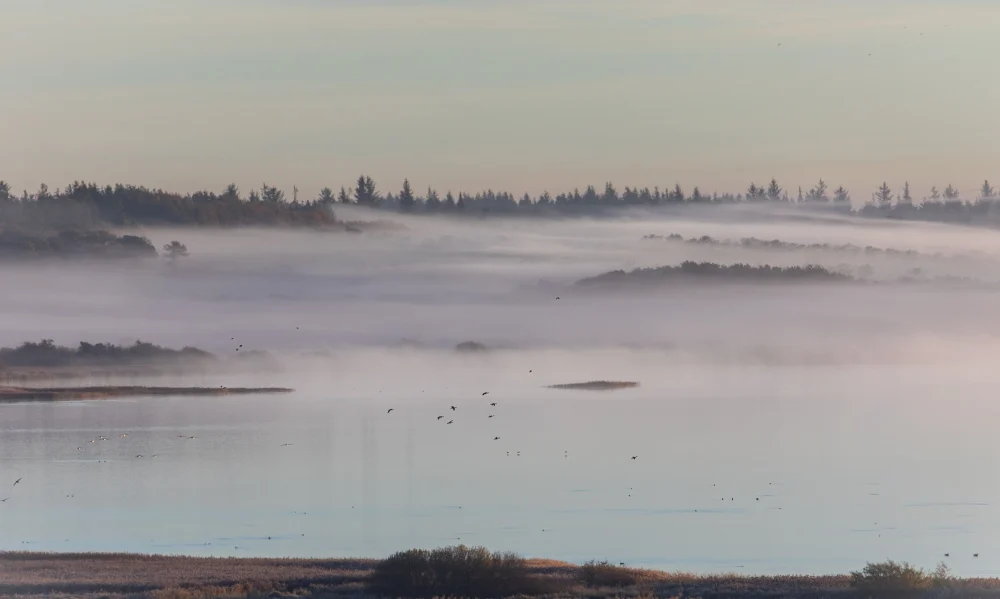
The name is old folk meteorology, and the rule behind it is simple: when the water and the soil are warmer than the air above them, vapour rising off the surface condenses into fog — most readily on clear, still nights, when nothing insulates the ground.
When the bog woman brews, the day ahead is usually a good one. Farmers once read her pots the way we read an app.
Aunt to the elf maidens
She is not alone out there. In the oldest Danish belief she belonged to de underjordiske, the ones below, and was kin to the elves — their faster, their aunt, as H. C. Andersen has it in The Girl Who Trod on the Loaf. When the fog rippled, people said the elves were dancing. A morning when they were dancing was not a morning to go wandering. The fog took your bearings and the stories took your nerve. In a country whose great bogs could swallow a wagon, that was a warning wearing a fairy tale’s clothes.
The road through the wood
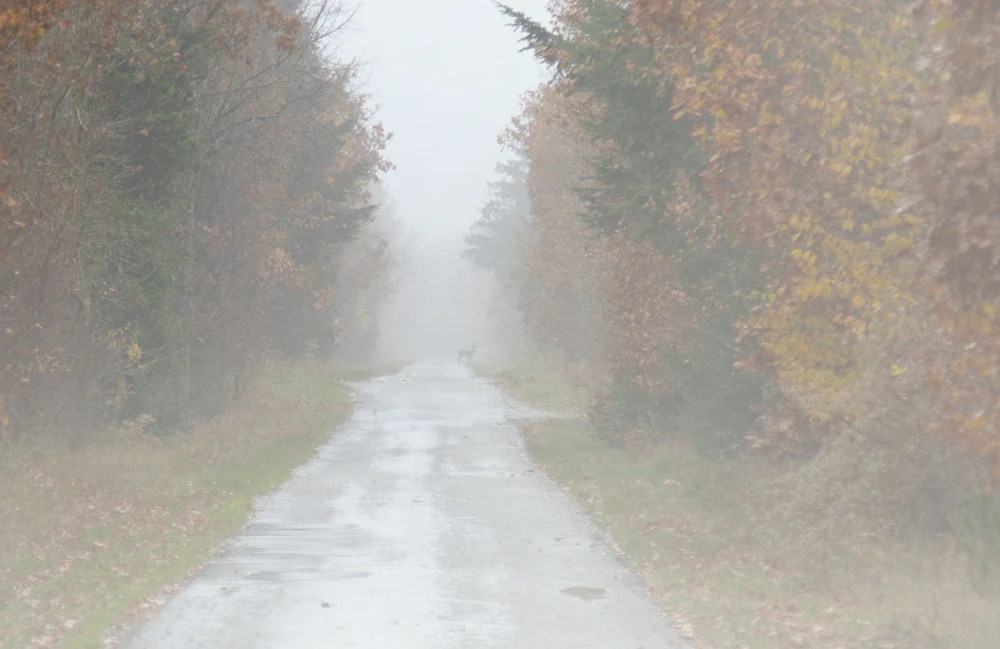
First comes a small road, barely wide enough for two cars and rarely used by even one, running the best part of six hundred metres through the wood – towards the lake. The oaks and maples have not let go yet – yellow up there still, and rust, and a deep copper where the light gets through – but the canopy is thin now, more suggestion than roof. What it does is glow faintly, as though the trees were a low-warmth bulb in a white room.
I have been in woods since I was a child, and on a morning like this the ears work before the eyes. A jay starts up somewhere above and to the right – that flat, rasping alarm they make when something is moving that they would rather wasn’t – and a second one answers, further off, and the two of them pass me along the lane like a rumour. I cannot see either bird. I don’t need to.
Underfoot, most of the leaves are already down. The lane is laid with them. Wet, packed, silent. Twice I catch sight of a figure at the edge of the fog; it is a fallow deer crossing the road, and then there is nothing at all.
Down to the lake
The fog has flattened the world into two layers – white above, brown and gold beneath, grass beaded and heavy, leaves giving off that smell they only give off when they are properly soaked.
At fifty metres out, the lake simply is not there. I know where the reeds give way to open water, and it does me no good, because there is only a soft grey wall where the horizon should be. Then the wind shifts at the far end and a margin of dark water appears and is gone again, as if someone had opened and closed a door.
And out of that grey wall comes a sound I have known since I was small: the heron’s hoarse, unlovely screech, off to my left and further out than it sounds. On a clear day I would have found the bird on my first sweep of the shoreline. This morning I stand on the bank listening to a heron I cannot see, and it is somehow a better bird for it.
The water is maybe nine degrees, the air four – precisely the condition required – so I can watch her working from the bank. Thin ribbons of vapour peeling off the lake, rising, joining, drifting…
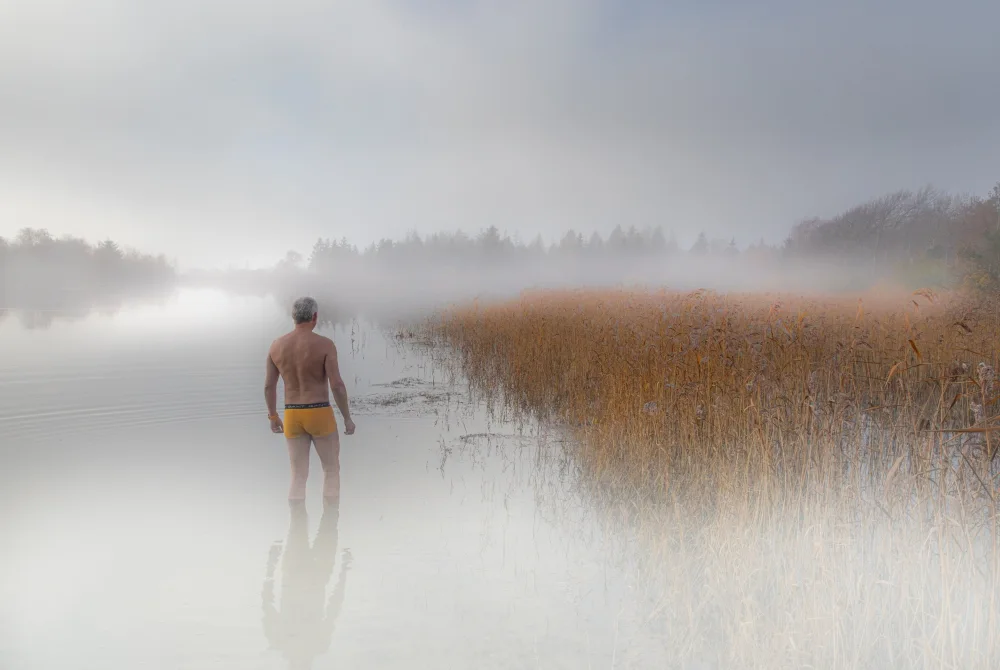
I go in fast, because there is no other way. The cold takes your breath in one sharp bite, then settles into something you can work with, and you swim into a white room with no walls.
I get control of my breathing, find my calm – and stay in the water for about a minute before I head for the bank and find the towel, which feels blessedly warm.
What the fog gives back
By the time I am dressed it is going – thinning from the top down, the way it always does – and the country comes back in the order it went.
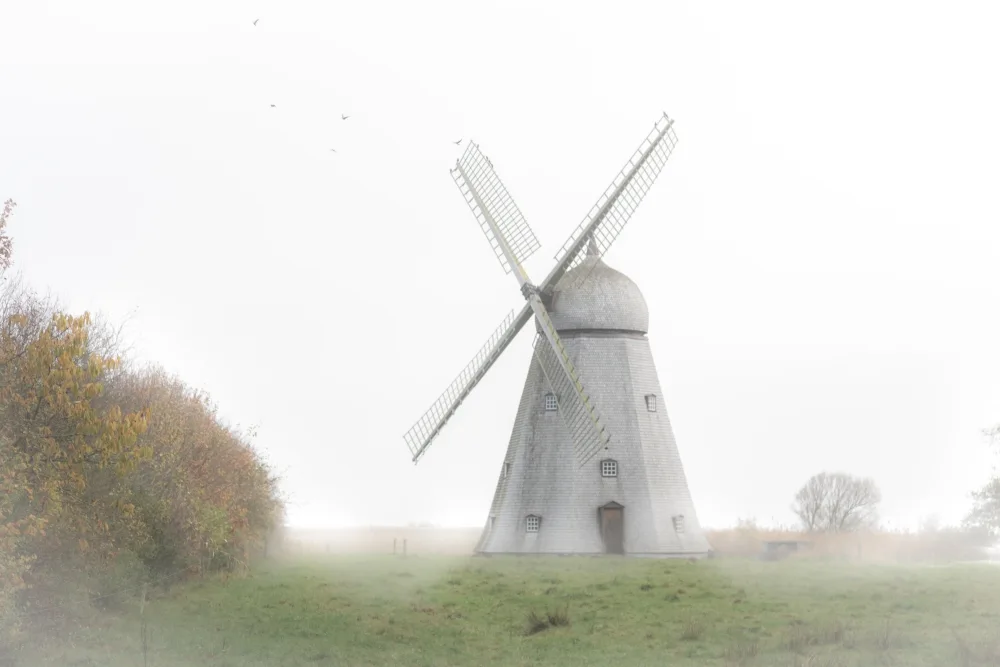
I walk back up through the wood, and it is only as I come round the barn that the old mill appears behind it, standing exactly where it has stood the whole time, in the ordinary grey light, having been absent from the world for the length of one morning.
And then the coffee. Steam off the cup, the kitchen warming up around me. A fantastic morning, and it is not yet half past eight.
That is the thing about mosekonebryg. The bog woman does not stay for the morning. She brews, she drifts, she disappears.
A morning like that one costs nothing! It is a walk, a swim, and a walk back – and I will be thinking about it for weeks, and probably in July, when the water is warm and the fog is a rumour.
Some of the nature that stays with me longest lies a short distance from most of us: a wood, a lane that no one else is using at that hour, a lake. It asks for nothing but eyes and ears that are open. If this piece has a purpose beyond the pleasure of writing it down, it is that – that more people should know these mornings are there, are free, and are waiting on an ordinary Saturday in November.
The trick is not always to travel further. It is to notice what is lying at our feet.